The Last Judgment takes place every day
In Albert Camus's The Fall, the former Parisian lawyer Jean-Baptiste Clamence delivers a radical redefinition of eschatology, asserting that the Last Judgment is not a future, divine event but a perpetual, immanent process carried out by human beings. This declaration is the cornerstone of his bleak anthropology and the justification for his self-invented vocation as a judge-penitent. Clamence's formulation strips the concept of its traditional religious transcendence and relocates it within the relentless, everyday machinery of human social interaction, where every person is simultaneously judge and accused.
The Rejection of a Future Judgment
Clamence explicitly dismisses the conventional idea of a deferred, final reckoning. When his unnamed interlocutor mentions the Last Judgment, Clamence responds with a mocking, respectful laugh: "Allow me to laugh respectfully. I shall wait for it resolutely, for I have known what is worse, the judgment of men." For him, the judgment of men is more terrifying because it offers no extenuating circumstances; even good intentions are ascribed to crime. He illustrates this with the image of a "spitting-cell," a human invention where a prisoner, wedged into a box with only his face visible, is repeatedly spat upon by passing jailers. This, Clamence argues, is a "human invention" that required no divine assistance. The true horror, therefore, is not a future divine tribunal but the immediate, inescapable, and merciless judgment that humans inflict on one another every day.
The Daily Occurrence of Judgment
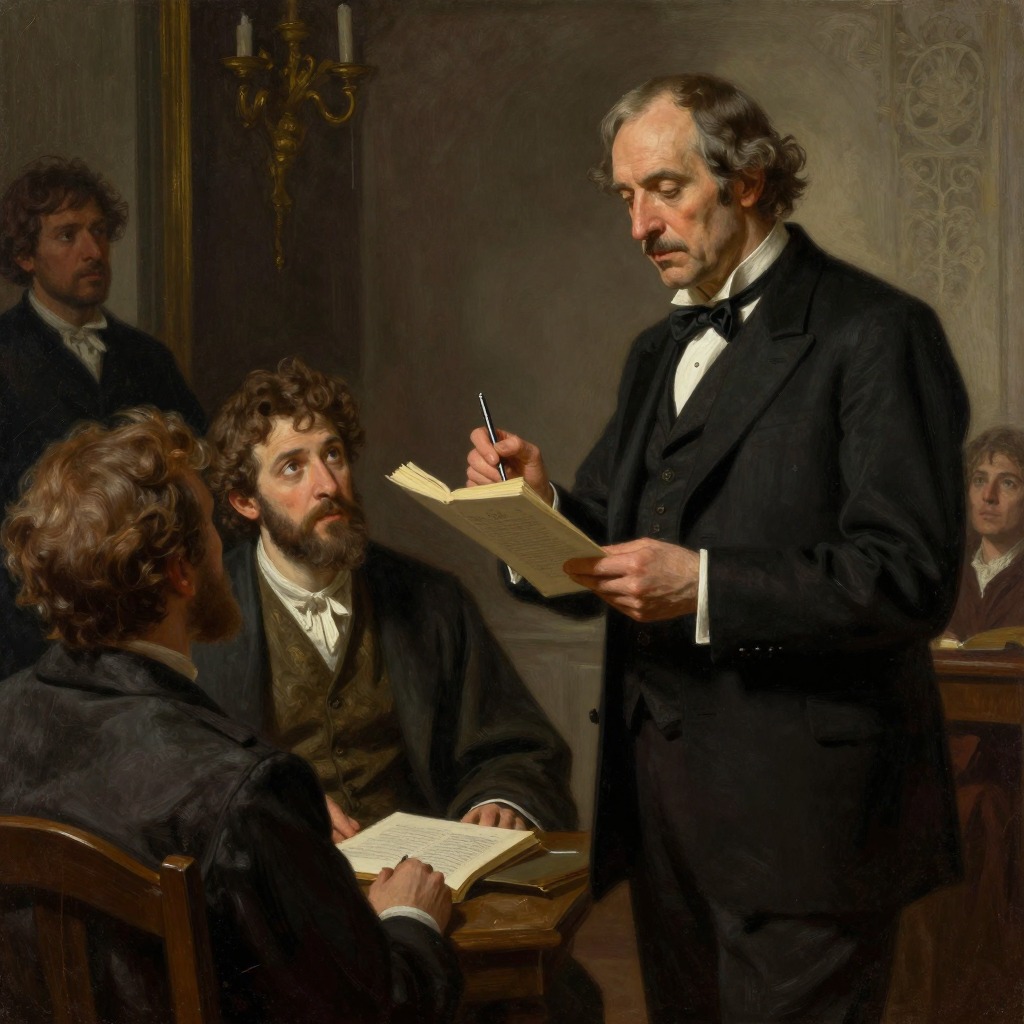
Clamence's central thesis is that the Last Judgment is not a single, culminating moment but a continuous reality. He states this with aphoristic finality: "Don't wait for the Last Judgment. It takes place every day." This idea is the logical conclusion of his belief that "every man testifies to the crime of all the others." In a world without God or a transcendent moral law, human beings become each other's judges, creating a closed system of mutual accusation. Clamence sees this as the fundamental condition of modern life, a state of universal guilt where innocence is impossible. The only escape, as he has discovered, is not to be innocent but to become the judge oneself, a role he achieves through the elaborate performance of public confession.
The Function of the Idea in Clamence's Philosophy
The redefinition of the Last Judgment as a daily occurrence is essential to Clamence's own psychological and philosophical project. It allows him to argue that since everyone is already guilty and already judging, the only logical response is to embrace the role of the judge-penitent. By confessing his own sins publicly and elaborately, he forces his listener to recognize their own complicity in the same universal guilt. This, in turn, gives Clamence the right to judge them. He describes his technique as a kind of Copernican reversal: "Inasmuch as one couldn't condemn others without immediately judging oneself, one had to overwhelm oneself to have the right to judge others." The daily Last Judgment, therefore, is not merely a description of reality but a tool of power. It provides the framework for Clamence's "democracy of guilt," where all are equally condemned, and he, by virtue of being the first to confess, sits enthroned as the supreme judge. He envisions himself at the summit of a "Dutch heaven," watching the multitude of the Last Judgment ascend toward him, feeling at last that he is being adored.